
Clarisse Mideva

1. Background
For many MSMEs and Innovators, Intellectual Property (IP) is often viewed as a legal concept, irrelevant to early-stage enterprises, small businesses and too complex to navigate or too costly to pursue. Intellectual Property (IP) refers to creations of the mind, such as inventions, literary/artistic works, designs, and symbols, protected by law to grant innovators/creators exclusive rights, enabling them to profit from and control the use of their creations, fostering creativity and economic growth. IP is intangible, unlike physical property, and its rights grant owners the power to commercialise their creative works or innovative products or to prevent unauthorised use.
In practice, IP is always an afterthought until a crisis occurs, e.g. a brand is copied, a product is imitated, content is misused, or a business faces a legal dispute. By the time these issues arise, the opportunity to proactively protect and leverage IP has been lost, resulting in a weakened market position and lost revenue. This gap between innovation and IP protection has left many promising ideas exposed, unprotected and underutilised. As a result, innovations that could contribute meaningfully to economic growth and competitiveness remain vulnerable.
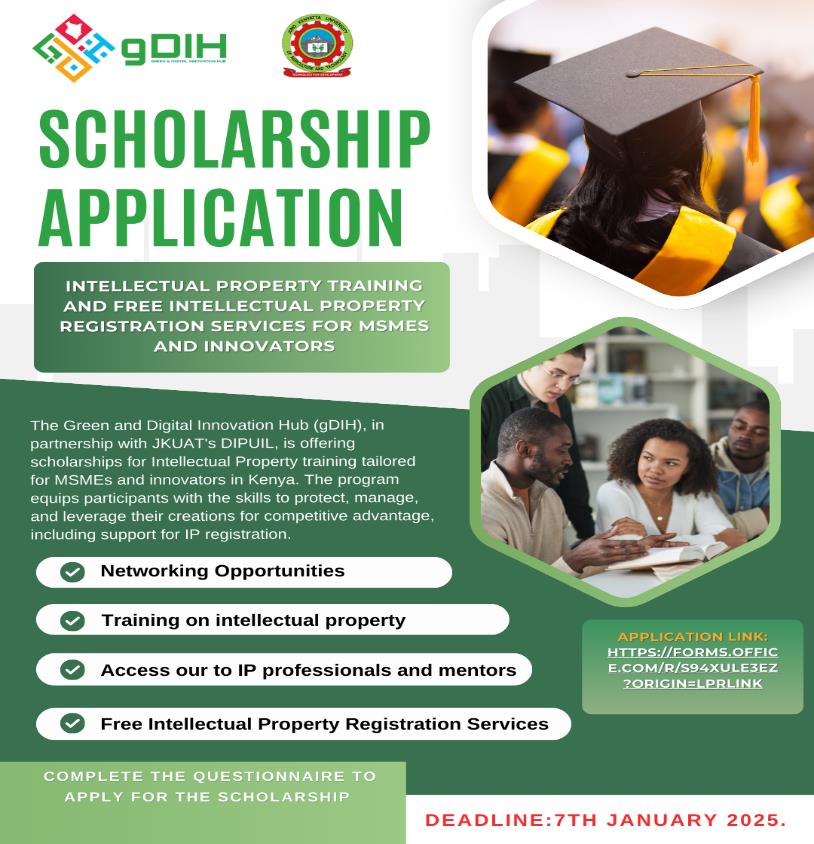
To address this gap, the Green and Digital Innovation Hub (gDIH), in partnership with Jomo Kenyatta University of Agriculture and Technology (JKUAT) – Directorate of Intellectual Property Management and University-Industry Liaison (DIPUIL) – offered a scholarship for training in Intellectual Property for MSMEs and Innovators across Kenya. This scholarship aimed to support and empower MSMEs and innovators with the knowledge and tools needed to protect their creations and drive value from their innovations. It also sought to enhance the capacity of MSMEs and innovators to understand, manage, and leverage IP for competitive advantage and provide assistance with IP registration to safeguard their innovations.
2. Challenge
A Needs Assessment involving 229 respondents was conducted, and many MSMEs and Innovators demonstrated strong technical and creative capacity but had limited understanding of IP rights such as trademarks, patents, copyrights, industrial designs, plant variety rights and utility models. For most, IP was perceived as either too complex, too expensive or as something only relevant to large corporations. Due to this, innovators risked losing their IP assets, brand identity, market advantage and potential revenue to imitation and unfair competition.
While respondents could clearly articulate their innovations, few could identify which aspects were protectable or which IP tools were most suitable for their businesses. Access to professional IP drafting services was limited, and navigating institutions such as the Kenya Industrial Property Institute (KIPI) and Kenya Copyright Board (KECOBO) remained a significant barrier. Without targeted intervention, these innovators would likely continue operating informally in relation to IP, undermining their long-term sustainability and Kenya’s broader innovation and IP performance indicators.
3. Intervention
Phase I involved training and IP support services. The training adopted a highly practical approach. Building on lessons from the Needs Assessment Report and the Pilot phase, a comprehensive IP training project was delivered to a cohort of over 100 MSMEs and Innovators from diverse sectors and counties. Although initial feedback suggested a preference for hybrid delivery, the project was delivered fully online to ensure inclusivity and accessibility, particularly for participants based in remote regions. The training moved beyond theory and focused on helping innovators identify their own IP asseTs, understand protection pathways and appreciate the commercial value of IP. Following the training, 9 (nine) innovators were shortlisted for focused IP support based on clear criteria: active participation, stage of innovation, clarity of protectable IP, commercial potential and willingness to engage deeply in the process. These innovators represented sectors including ICT, agribusiness, waste management, and emergency response, which are highly relevant to Kenya’s development priorities and align with the gDIH’s sectors.
The IP support involved individualised consultations, IP screening sessions and tailored guidance on suitable protection mechanisms. Innovators were supported in developing strategies aligned with their business models, in IP drafting & filing support, and in navigating the requirements of KIPI and KECOBO. This support was enhanced in Phase 2, in which the innovators were financially supported to file for IP protection.
4. Impact
4.1 Protection and Opportunity
By the end of the assignment, 8 (eight) innovators received direct IP registration support. This included multiple trademark applications, one copyright registration and the initiation of two
patent drafts. For many beneficiaries, this marked their first formal engagement with the IP system.
The most immediate change was increased confidence in the IP system. Innovators who previously viewed IP as inaccessible began to see it as a practical business tool. They gained clarity on the timelines, procedures and costs and developed stronger sense of ownership over their innovations. Importantly, IP literacy improved, not just in terms of definitions, but in understanding how IP supports branding, marking entry and investor readiness/engagement.
One agribusiness innovator, for example, was able to initiate trademark protection for a product that had already gained local market traction, reducing the risk of imitation as the business scales. Another technology-based innovator moved forward with patent drafting, positioning the innovation for future licensing or partnership opportunities.
Beyond IP filing, this IP support contributed to long-term systemic change. By demystifying IP processes and embedding mentorship into the support model, the project strengthened the link between innovation, formal protection and commercialisation. Innovators became better prepared for incubation projects, funding opportunities and market expansion, which are the key milestones for sustainable business growth.
4.2 Long-term impact
The expected long-term outcomes of the IP support extend beyond the immediate beneficiaries. Protected IP enhances the competitiveness of MSMEs in both domestic and export markets, supports investor readiness and increases the likelihood of successful commercialisation. At the national level, increased IP filings contribute to stronger innovation output indicators (as reported in the Global Innovation Index) and reinforce Kenya’s position as Silicon Savannah and a regional innovation hub.
The shift in mindset is also important. The project demonstrated that IP support does not need to be abstract or elitist. When delivered in a structured, practical and inclusive manner, it becomes a powerful enabler of innovation. Combining training, professional support and institutional collaboration offers a scalable framework for future interventions that can foster innovation not only in Kenya but in Africa as a whole.
Conclusion
This story of change illustrates how targeted IP support can transform innovation from an informal activity to an economic asset. By creating awareness and practically supporting innovators to register their IP rights, the support helped ensure that innovation/creativity translates into commercial value. In doing so, individual innovators are not only supported but the foundations of Kenya’s IP-driven development pathways are also strengthened.
Importantly, the support also generated learnings for ACTS and the gDIH. The tested model of training and IP services provision provides a framework through which ACTS and gDIH can embed IP protection and commercialization across Kenya’s wider research and Innovation system, especially since ACTS is now a do-tank.