
By Brandon Chagema
Introduction
In Kenya’s rapidly evolving digital economy, digital literacy is becoming more of a necessity than a luxury, as it is essential for meaningful participation in modern jobs, entrepreneurship, and societal innovation. However, a significant skills gap persists, particularly among youth, women, and micro-entrepreneurs, as these opportunities remain out of reach due to persistent gaps in digital skills, limited access to training, and low awareness of emerging digital pathways.
The Green and Digital Innovation Hub (gDIH), in collaboration with the Jomo Kenyatta University of Agriculture and Technology (JKUAT), through JHUB Africa, made strides to bridge this gap by equipping Micro, Small and Medium Enterprises (MSMEs) and individuals with the digital tools and skills necessary for the twin transitions toward digital and green economies. At its core, the program sought to demystify technology, make digital spaces more accessible, and equip participants with skills that could translate into real livelihoods.
Challenge
Despite Kenya’s growing digital economy, many aspiring innovators and young professionals face structural and social barriers that limit their participation. Formal education systems often lag behind industry needs, leaving learners with a lot of theoretical knowledge but few practical skills. At the same time, informal innovators, particularly women and youth from underserved communities, are frequently excluded from digital conversations due to limited access to training opportunities, mentorship, and relevant networks.
Another critical challenge was awareness, as many potential beneficiaries were unfamiliar with how digital skills could be applied to their own contexts, such as in agriculture, small businesses, creative industries, or community development. Technology was often perceived as complex, expensive, or reserved for “experts,” reinforcing self-doubt and limiting participation. For women and marginalized groups, these challenges were accompanied by gender norms, time constraints, and limited exposure to role models in digital spaces. Without targeted interventions that build both awareness and technical skillsets, the digital divide would continue its cycles of existing inequalities, thus limiting Kenya’s broader socio-economic potential.
Intervention
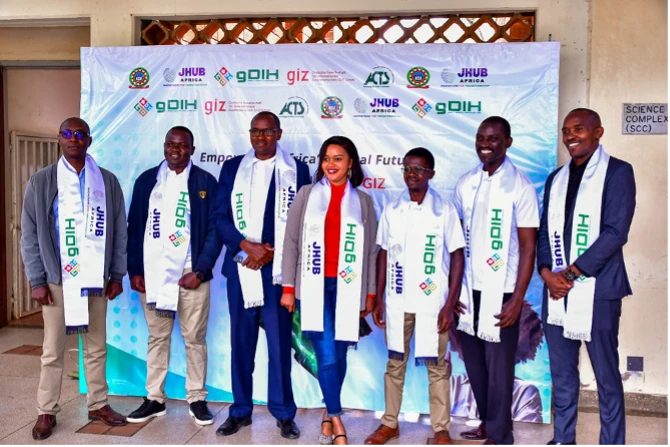
The Digital Skills Training and Awareness Program, implemented by gDIH in collaboration with the Jomo Kenyatta University of Agriculture and Technology (JKUAT) through JHUB Africa, was designed as an inclusive, hands-on initiative aimed at transforming how MSMEs and individuals engage with digital technologies. The program was intentionally structured to blend practical digital skills with real-world entrepreneurial application. The comprehensive curriculum spanning engaged applicants in modules covering Digital Marketing, AI for Business, Data Literacy, and Web Development, all tailored to business contexts.
Capacity building was delivered through a combination of immersive workshops, expert mentorship, and peer-learning platforms that encouraged interaction, experimentation, and collaboration. Facilitators from industry and academic experts focused on positioning digital skills as tools for opportunity rather than abstract concepts. A key pillar of the intervention was ensuring participants left with both confidence and competence, as learners were encouraged to apply newly acquired skills directly to their enterprises, develop online presences, leverage data for decision-making, and adopt AI tools for operational efficiency.
There was also the creation of community and professional networks such as mentorship sessions that connected participants with some seasoned innovators and business leaders. The gender-inclusive outreach ensured that women entrepreneurs were actively supported, thus amplifying their visibility and participation in digital spaces. Ultimately, the intervention combined skill acquisition, awareness building, and community integration to spark sustainable digital transformation at both individual and enterprise levels.
Impact
The Digital Skills Training and Awareness Program generated multifaceted impacts. For many entrepreneurs, the ability to market products online, leverage data insights, and apply AI-driven tools marked a dramatic shift in how they conducted business. Graduates reported expanded customer bases, increased revenue, and improved operational efficiency, thus demonstrating how strategic digital adoption can transform micro-businesses into competitive, future-ready enterprises.
Tracy Odero, a graduate of the program, shared how digital skills tripled her customer base through online orders and broadened market reach. She was the only lady in the program to graduate, and stated how the program has revolutionized her life, and helped her even more than her Bachelor of Commerce Degree. From the training, she has managed to build and curate her website, www.ridewaystore.com, an online shopping store, where she aims to become as big as, or even bigger than Jumia. Tracy also shared that she has trained 2 other women on what she learnt, and is helping them perfect it like she has. Hear her story on the link below:
Tracy Odero: Empowered to Create: Digital Skills Training 2025 Graduate Stories
In the same way, established entrepreneur, Dr. Boniface Muli who deals with clean energy found his passion for learning Python, Jupiter, amongst other coding languages. The call for the program was shared to him by some friends, and he took a chance. He is now using data in his businesses, where he is able to create his logo, engage in his active social media, and impressively, is about to leverage data in his businesses, enabling him to design his logo, engage on social media, and complete his business website. Hear his story on the link below:
Dr. Boniface Muli: Empowered to Create: Digital Skills Training 2025 Graduate Stories
Conclusion
The Digital Skills Training and Awareness Program demonstrated that digital empowerment is as much about human agency as it is about competency building. Through accessible, context-relevant training, gDIH in collaboration with JKUAT through JHUB Africa effectively transformed digital learning into a catalyst for empowerment, innovation, and economic participation.
Participants did not just acquire skills, but they also redefined what was possible for their businesses, communities, and personal trajectories. The program’s success underscores the importance of pairing technical training with mentorship, community support, and applied learning opportunities, thereby creating a sustainable model for digital transformation that is anchored in lived experience.
This program had a few challenges such as gender imbalance, rural underrepresentation, high participant drop-off rates, and scheduling conflicts with work commitments, all of which the second phase of the program that is currently ongoing seeks to address, while also scaling up the impact.
References
Green and Digital Innovation Hub (gDIH), 2025. Digital Skills Training and Awareness Programme. [online] Available at: https://www.gdih.org/digital-skills-training-and-awareness-program/
JHUB Africa, 2025. From Dream to Reality: JHUB_gDIH Program Transforms Kenya’s Agro-Entrepreneurs Through Digital Innovation. [online] Available at: https://jhubafrica.com/from-dream-to-reality-jhub_gdih-program-transforms-kenyas-agro-entrepreneurs-through-digital-innovation/