
By Joel Onyango, Faith Kemunto, Peter Ongalo
Why COP31’s priorities mattered
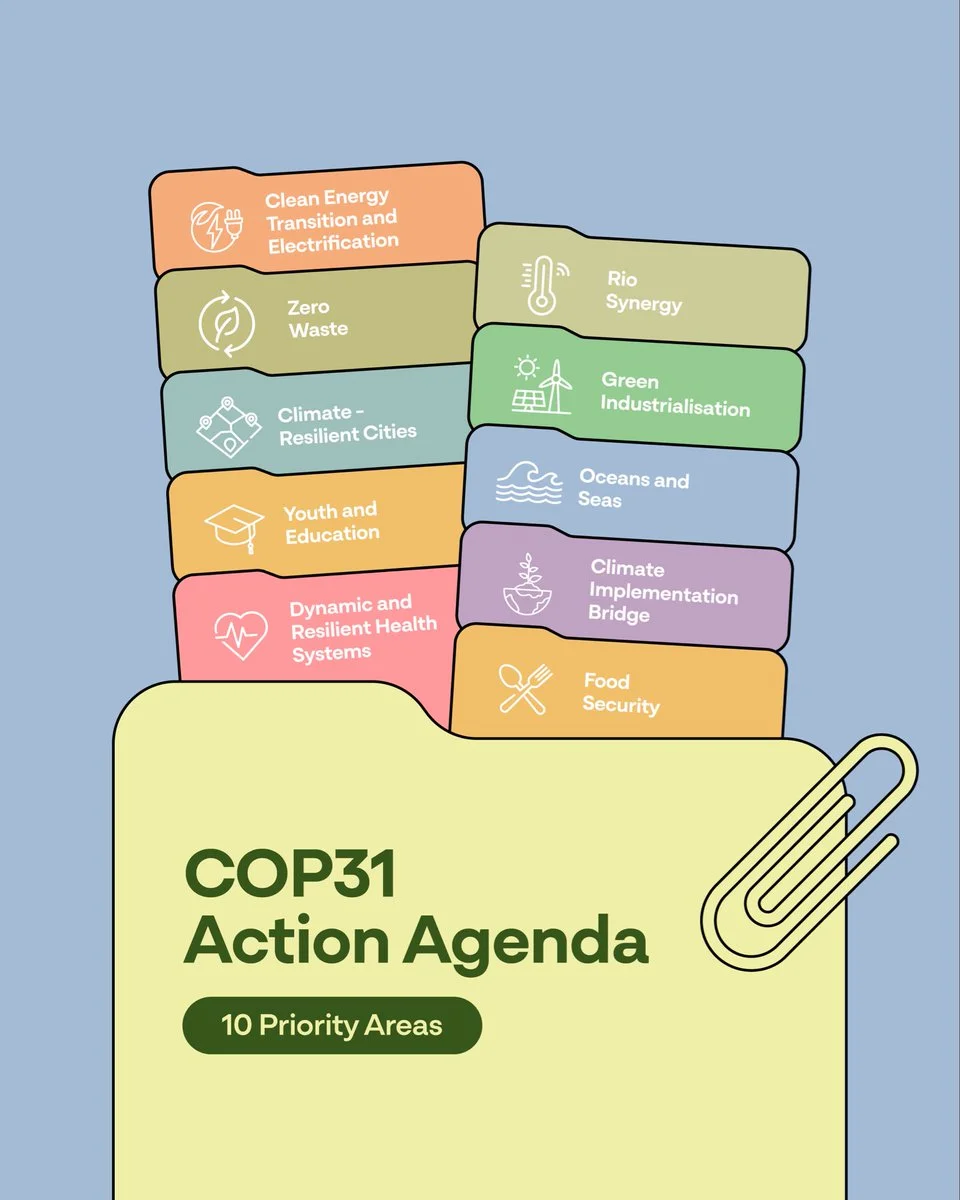
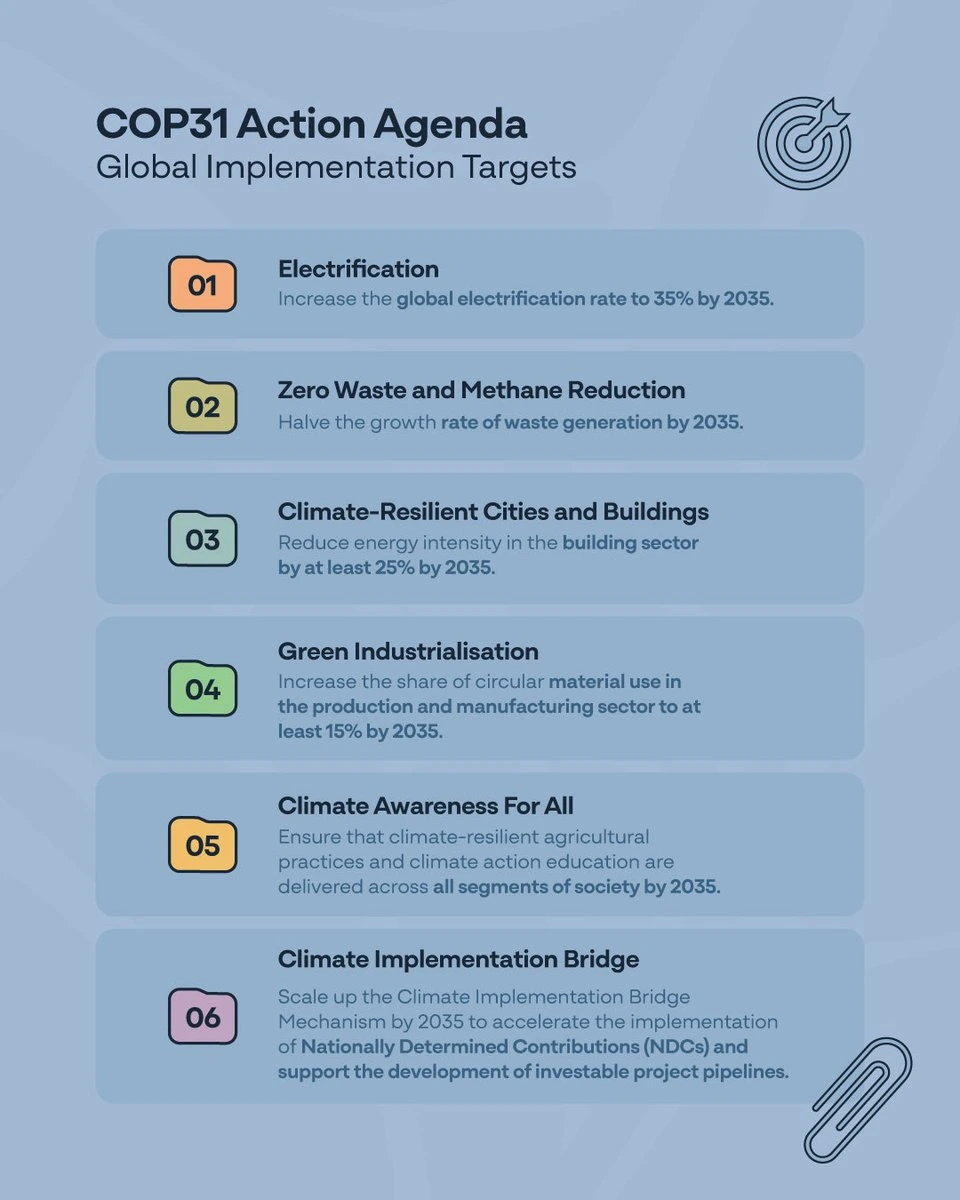
COP31 in Antalya was billed as the “COP of implementation and acceleration” [1]. It arrived with a short list of tests that mattered far beyond the Mediterranean coast. Could the world agree to raise electricity’s share of final energy from about a fifth to 35% by 2035, Türkiye’s flagship “35-by-35” goal [2]? Would the promise made in Belém to triple adaptation finance by 2035 finally carry a number, the US$120 billion a year that African and least developed countries demanded [3]? Would the Just Transition Mechanism agreed at COP30, now called the Belém-Antalya Mechanism, be born with real functions and resources [4]? And the draft text itself expressed “deep concern that global peak warming is projected to exceed 1.5°C” [5].
For Africa, these were not abstract questions; they were directly linked to energy access, economic development, climate resilience and the capacity to create sustainable livelihoods. More than 80% of the roughly 655 million people without electricity live on the continent [6]. Adaptation needs run to hundreds of billions of dollars a year, while flows remain a fraction of that. And COP32 will be held in Addis Ababa in 2027, so whatever Antalya leaves unfinished lands on an African table.
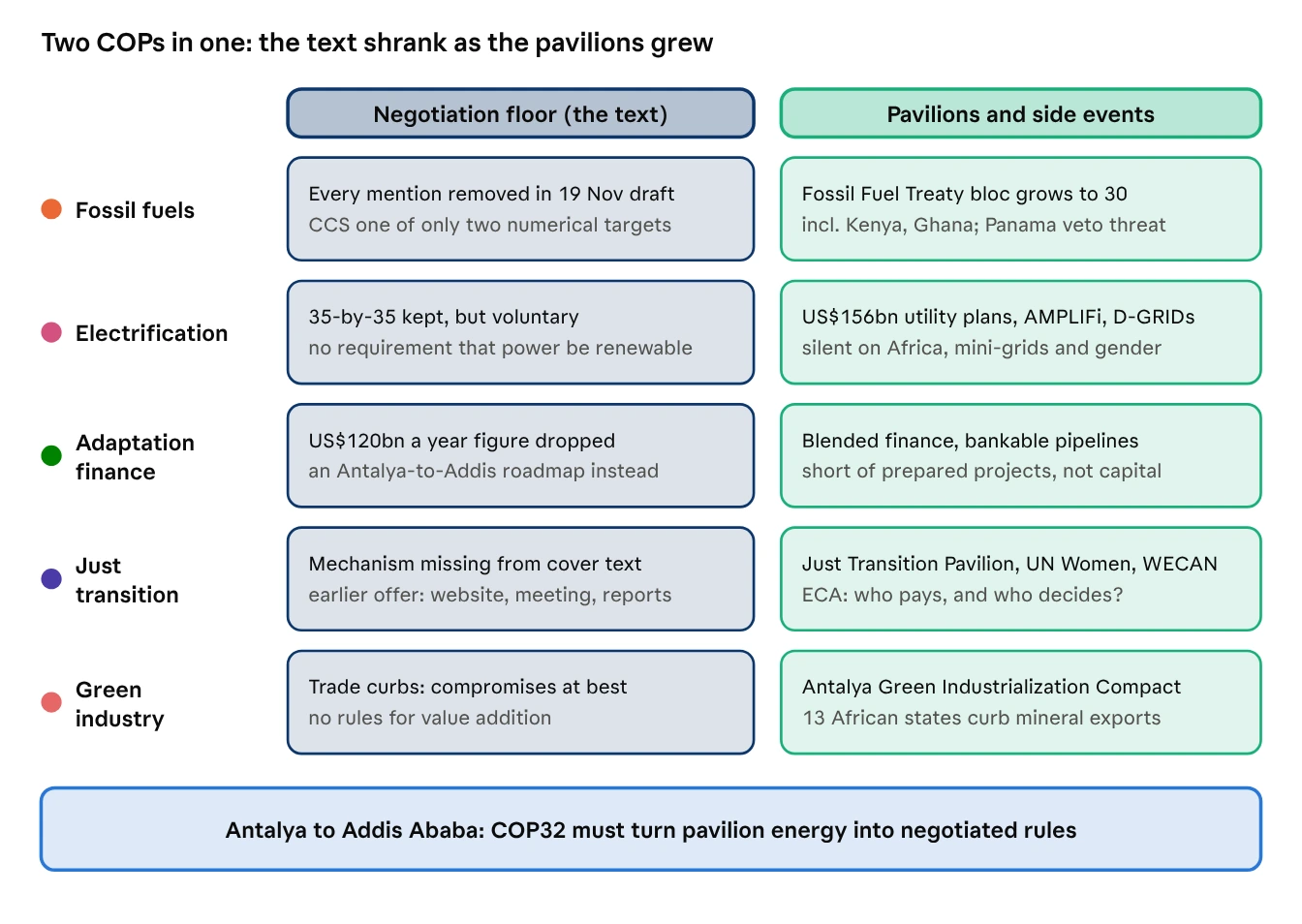
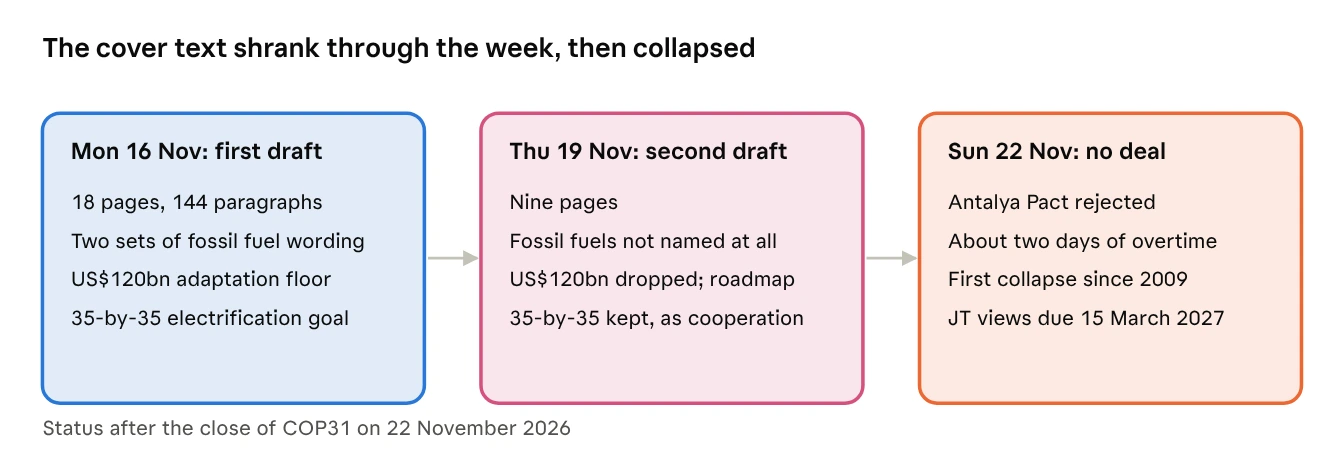
Looking back from the close of the talks, which ran almost two days over time and ended without an overarching agreement (see the postscript), a striking pattern has emerged. There were really two COPs in Antalya. In the negotiating rooms, the text grew thinner by the day: the second draft cover decision, released on 19 November, removed every direct reference to fossil fuels, dropped the US$120 billion figure and left out the Just Transition Mechanism [1][3]. Meanwhile, in the pavilions and side events, the conversation was expansive, confident, and centred on investment opportunities: grid investment plans, green industrialisation compacts, a fossil fuel treaty bloc, nature finance, and blue economy deals [2][6][7]. This blog sets the two discourses side by side, argues that the gap between them is the real story of COP31, and asks what COP32 must do to close it (Figure 1).
Dichotomy 1: Fossil fuels named in the pavilions, erased from the text
On the negotiating floor, the week’s arc was a retreat. Monday’s first draft carried two sets of wording on fossil fuels, the 2023 “transitioning away” language and a stronger “phase out” [8]. By Thursday, the second draft had removed all direct references to fossil fuels and dropped the roadmaps for moving away from them [1]. Power Shift Africa’s Mohamed Adow warned of a “ghost COP” [3]. Saudi Arabia and Russia opposed the language; the Arab Group pushed instead for carbon capture and storage, which became one of only two numerical targets left in the text [3].
In the pavilions and corridors, fossil fuels were named loudly and specifically. The bloc of countries developing a Fossil Fuel Treaty grew to 30 nations, with Kenya, Ghana, Panama, Nepal, Guatemala and Saint Vincent and the Grenadines among the latest to join [7]. Panama wrote to the presidencies, threatening to block any deal that does not cap global oil production and act on methane [9][10]. Business voices on LinkedIn noted that fossil fuel transition is moving outside the text altogether, into national roadmaps published by a growing group of countries [11].
The dichotomy is stark. The consensus process rewards the most reluctant producer; the side-event space rewards the most ambitious coalition. For Africa, this split is double-edged. Two of the three countries in our Just Energy Transition (JET) research, Kenya and Ghana, are now in the treaty bloc, signalling ambition. Yet the same countries need finance, technology and local industry to make any transition just. While calling for a transition away from fossil fuels in international forums signals ambition, implementing that transition within national economies requires substantial investment, policy alignment, technological capacity and measures to protect workers and affected communities [12]. That cost was exactly what the negotiators could not agree to share (Figure 2).
Dichotomy 2: Electrification as a voluntary pledge in the text, a billion-dollar showcase in the pavilions
Electrification survived the second draft where fossil fuel language did not. The 35-by-35 goal remains, but as a menu item for cooperation rather than a firm obligation, and around 75 countries are reported to back the voluntary pledge, though Türkiye has not published a list [3][11]. Crucially, the proposal does not require the added electricity to come from renewable sources [13]. 350.org warned it could become a “Trojan horse” for the energy demands of data centres [14].
The Action Agenda told a far more confident story. On 19 November, the Electrification Delivery Package brought together power utilities’ annual investment plans of at least US$156 billion across grids, renewables and storage, a new Climate Investment Funds mechanism (AMPLIFi) seeded with £400 million to mobilise up to £5 billion, and a Türkiye-IRENA initiative on distribution grids in developing countries [2]. At an AU-EU roundtable, leaders argued that energy access, energy security and industrial development must be pursued together [6].
But look closely at what the showcase leaves out. The Delivery Package does not mention Africa, Mission 300, mini-grids, clean cooking or gender [2]. The AU-EU roundtable set priorities rather than quantified commitments, and did not address skills, women or youth [6]. On the floor, electrification is weak but at least universal; in the pavilions, it is rich but selective. Neither discourse asked the question that matters most for the 600 million Africans without power: who will own, manufacture, build, install and maintain the new electricity systems, and how will local enterprises, workers and communities benefit from these investments? A Nigerian climate advocate captured it on LinkedIn after the lights briefly went out near the press rooms: for African delegates, it was a reminder of a daily reality, not a glitch.
Dichotomy 3: Adaptation finance without a number, and the pavilions’ search for bankable projects
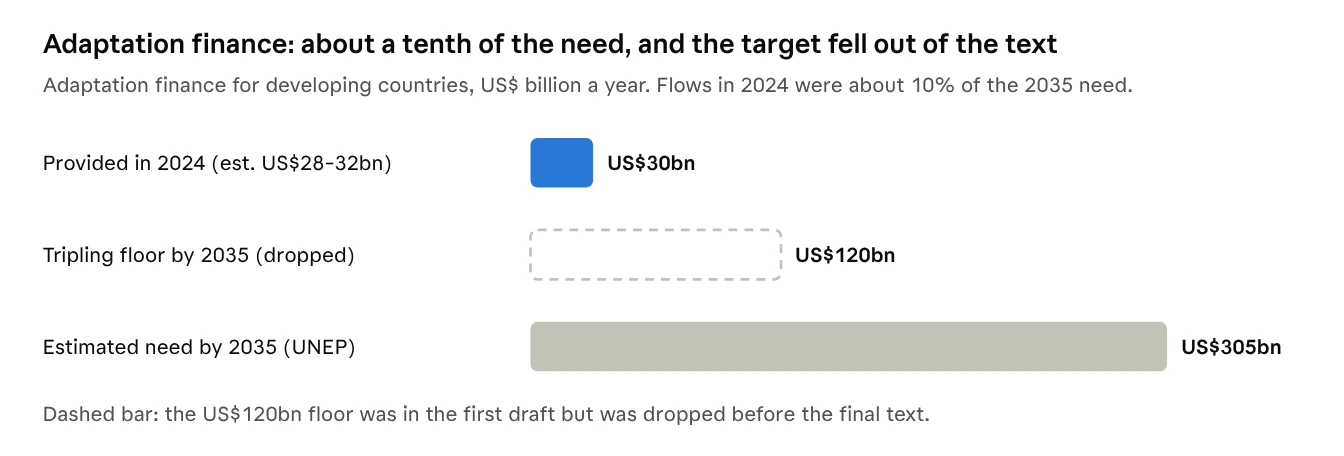
For African negotiators, the single most important number at COP31 was US$120 billion a year by 2035, the floor for tripling adaptation finance. The first draft carried it; the second draft dropped it, keeping only further discussion toward “tripling” [15]. In its place came an Antalya-to-Addis Ababa Roadmap for Adaptation and Resilience Finance, a report on the baseline by COP32 and an “implementation pathway” under the climate finance work programme, with no target and no baseline year [1][3]. Even the dropped figure would have covered only part of the need; the UNEP estimate cited in the first draft puts annual adaptation needs at US$305 billion by 2035 [16] (Figure 3). Greenpeace said the text “kicks crucial decisions on adaptation” down the road [3].
The pavilions spoke a different dialect of the same problem. Panels on blended finance, risk-sharing and “investment-ready pipelines” filled the Africa Pavilion, the MDB Pavilion and the Climate Finance Hub. At a Blue Deal Morocco session, a finance official summed up the mood: financiers are not short of capital; they are short of prepared projects and risks they can price [17]. WWF’s Africa Adaptation Hub and others called for grant-based and concessional finance that actually reaches communities [18].
Here the dichotomy is about who carries risk. The negotiation floor argues over public money owed by rich countries to poor ones. The pavilions discuss private money that will follow if the risks are made bankable. Communities need both, and financing mechanisms must connect international climate finance commitments with locally accessible resources that respond to communities’ priorities and capacities. That is the logic behind delivery vehicles such as the Blue Empowerment Fund hosted by ACTS in Kenya, which channels revolving, concessional credit through SACCOs and producer groups serving fisher and seaweed communities, with first-loss and guarantee options for investors and a target of more than 50% women and youth [19]. Models like this do not replace the public finance Antalya failed to quantify. They show where it should land.
Dichotomy 4: A just transition mechanism in name, a just transition movement in the halls
The Belém-Antalya Mechanism was meant to be one of COP31’s few concrete outcomes. Instead, the first negotiating text offered what more than 800 organisations from 109 countries described as little more than a website, an annual meeting and a set of reports, without the functions or resources to turn commitments into action [20]. Climate Action Network called it “a mechanism with responsibilities but no means” [21], and gave Türkiye’s presidency a dishonourable mention for meddling with it [22]. By the time the second cover text appeared, the mechanism was not mentioned at all [1].
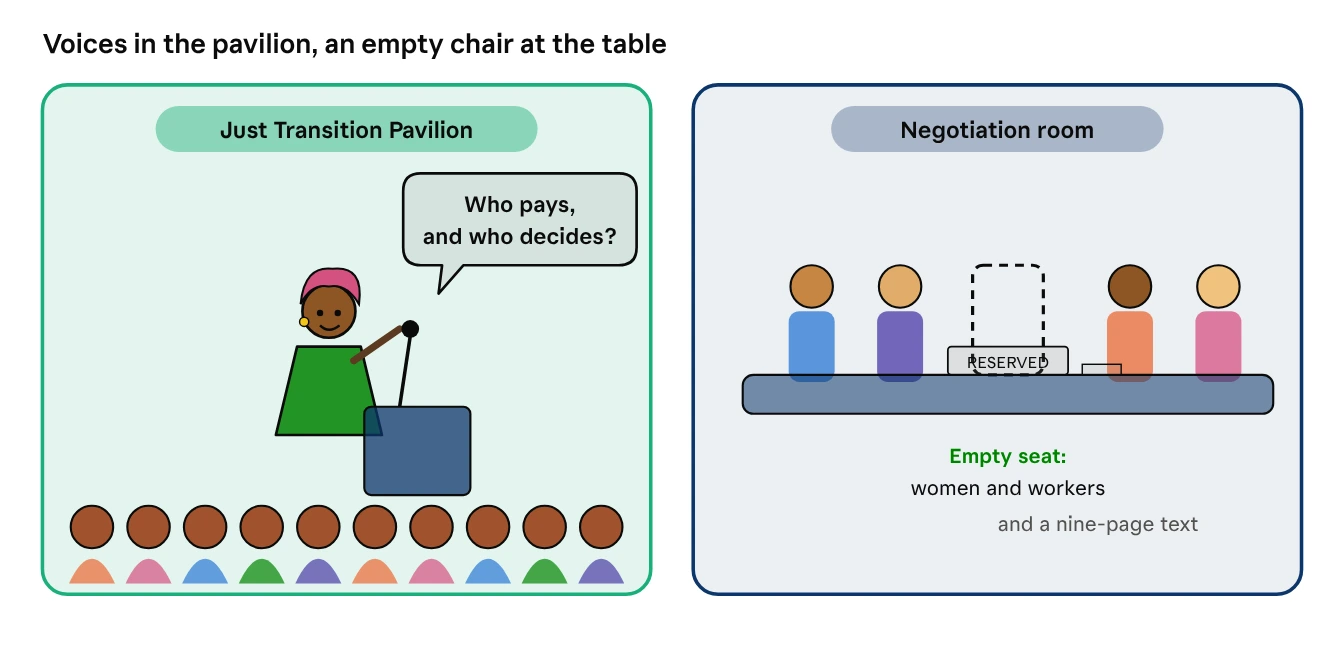
Outside the negotiating rooms, just transition was everywhere. The Just Transition Pavilion ran two weeks of sessions on skills and jobs, social protection, social dialogue and support for vulnerable groups [23]. UN Women launched its flagship Progress of the World’s Women 2026 report in Antalya; its accompanying fact sheet warns that women remain largely excluded from climate decision-making and that current trajectories point to at least 1.8°C of warming [24]. Women’s and Indigenous networks argued that no meaningful transition is possible without the leadership, rights, and resources of the women and communities defending the living world [25].
The question of participation also extends to workers’ representation. Evidence from the JET research in Kenya points to union membership of below 5% across the three study regions, highlighting gaps in collective representation within the renewable energy sector [26]. As the industry expands, strengthening social dialogue and worker participation will be important to ensure that employment opportunities are accompanied by decent working conditions, social protection, and opportunities for progression [27]. Without these considerations, the transition risks creating new employment opportunities while leaving existing labour market inequalities largely unaddressed.
This is the dichotomy I raised at our own COP31 side event: we have become good at counting women in the energy transition but not at measuring their influence. The pavilions are full of women’s voices; the negotiated text has no mechanism for those voices to shape budgets, procurement, or ownership. Our JET evidence from Kenya, Ghana and South Africa shows why this matters. Although women are increasingly participating in solar sales, installation and maintenance, their representation in higher-value technical roles, engineering, enterprise ownership and decision-making remains limited, while informality continues to characterise much of the sector’s employment [26]. A just transition mechanism without resources leaves that pattern untouched. Gender-responsive policy would track who moves up, not only who comes in (Figure 4). Equally important is strengthening workers’ representation and social dialogue to ensure that the expansion of renewable energy employment is accompanied by decent working conditions, social protection and opportunities for career progression.
Dichotomy 5: Green industrialisation in the pavilions, trade and technology fights on the floor
If one phrase defined Africa’s pavilions in Antalya, it was value addition. Governments want to stop exporting raw cobalt, manganese, lithium, and graphite and instead process and manufacture at home; the DRC and Zambia are cooperating on battery and electric-vehicle supply chains, and Zimbabwe is encouraging domestic lithium processing [28]. At least 13 African countries have introduced mineral export restrictions since 2023 to push processing onshore [6]. Governments launched the Antalya Green Industrialization Compact to unlock investment, create markets for cleaner industrial products and help developing countries access technology [29].
On the negotiation floor, the same ambitions appear only as contested trade and technology language. Trade curbs were among the charged issues on which the final-stretch text could only offer possible compromises [30]. These clauses are fought over as threats to competitiveness, not designed as industrial policy.
Our JET research shows why the pavilion ambition needs negotiated backing. In Kenya, decentralised renewables supported about 53,000 jobs in 2022, yet firms cluster in imports, logistics and assembly, and most jobs are informal [26]. Ghana’s solar capacity grew nearly a hundredfold in a decade while its import bill almost doubled between 2018 and 2023 [31]. South Africa, the continent’s deepest industrial base, still relies heavily on imported components [32], and irregular procurement stops factories planning production and keeping skilled workers [33]. Value addition cannot be announced at a pavilion; it must be supported through enforceable local content requirements, transparent procurement frameworks, accessible and affordable financing for SMMEs, technology transfer, skills development and trade policies that create space for domestic industrialisation.
These constraints also highlight the need to move beyond commitments to local content toward practical support for domestic enterprises. SMMEs require access to affordable financing, technical capabilities, appropriate technologies and predictable procurement opportunities to participate more meaningfully in renewable energy value chains [34]. Without these enabling conditions, localisation policies risk remaining aspirational, with local enterprises concentrated in lower-value activities while higher-value manufacturing and technological capabilities remain limited [35].
Towards Addis Ababa: closing the gap between the two COPs
Read side by side, the two COPs of Antalya are less opposites than halves of an unfinished sentence. The negotiating floor holds the legitimacy: universal participation, legal weight and the only forum where obligations can be agreed. The pavilions hold the energy: capital, coalitions, practical models and the voices of women, workers, youth and communities. The tragedy of COP31 is that each half spoke without the other. The text grew thinner as the pavilions grew louder.
On the final scheduled day, a further revised declaration was still expected and an extension was widely seen as likely, while UN climate chief Simon Stiell stressed that the 2023 agreement to transition away from fossil fuels still applies, whatever the final text said [36].
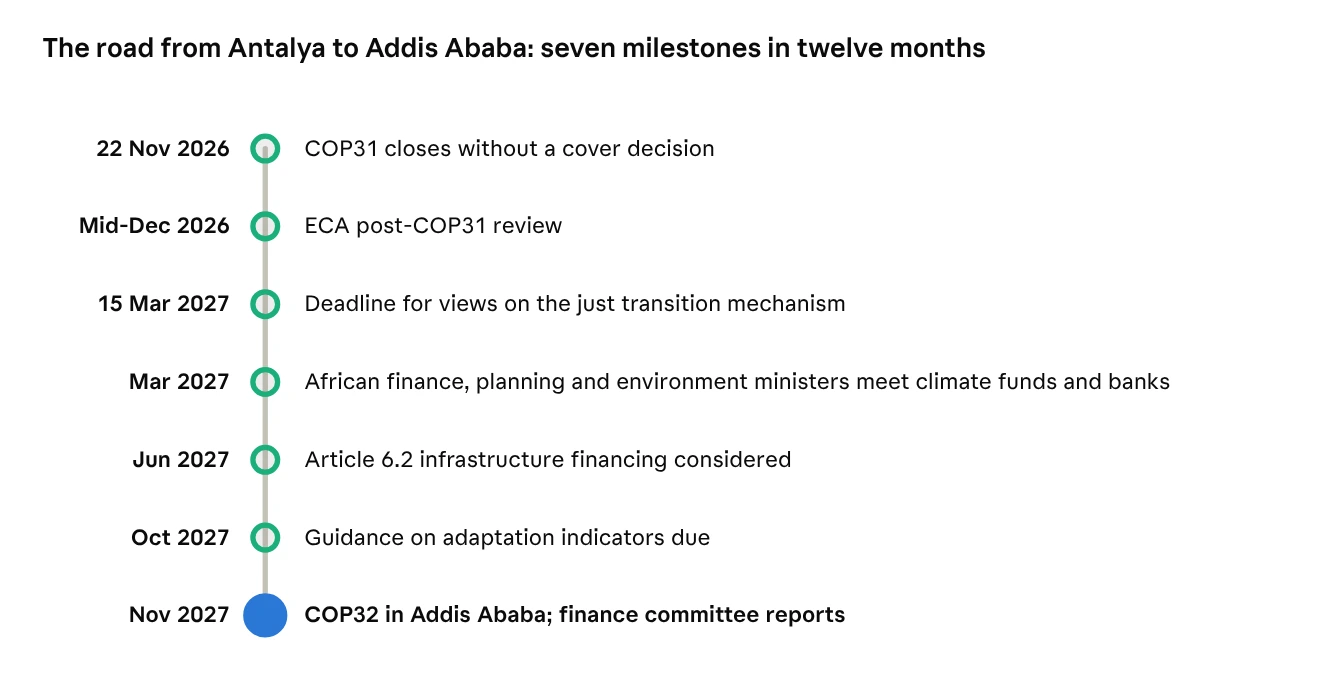
COP32 in Addis Ababa is Africa’s opportunity to join the sentence. Antalya has already written the bridge into its draft: an Antalya-to-Addis roadmap on adaptation and resilience finance, due to report by COP32 [1][3]. Ethiopia’s incoming presidency, together with the African Group of Negotiators, can use the coming year to turn pavilion ideas into negotiable proposals. The UN Economic Commission for Africa has already set the pace: at its Africa Pavilion event asking who pays for Africa’s transition and who decides, it announced a post-COP31 review in mid-December and a March meeting of finance, planning and environment ministers with global climate funds and development banks, ahead of COP32 [37]. Four moves would help.
First, put a number back on adaptation finance and attach a clear delivery mechanism, ensuring resources reach county governments, SACCOs, producer groups, and local institutions responsible for implementing adaptation priorities. Second, give the Belém-Antalya Mechanism the resources and functions it was promised, including finance mobilisation and meaningful participation of workers and women. Third, link electrification to energy access, local manufacturing, and decent work, so the 35-by-35 goal becomes a development agenda rather than an imported-hardware agenda. This requires deliberate support for SMMEs, technology transfer, skills development and procurement frameworks that enable domestic enterprises to participate in renewable energy value chains. Fourth, measure what matters: not only the number of women and young people participating in the transition, but also their representation in technical roles, enterprise ownership, leadership and decision-making.
The opportunity for a just energy transition in Africa is growing. Antalya demonstrated that political conversations are evolving, coalitions are forming, and investment interest is emerging. What is missing is the ladder: agreed rules, predictable finance and accountable institutions that let ambition climb from the pavilion to the policy. Addis Ababa should be the COP where Africa builds it.
Postscript: how Antalya ended, and what it means for Addis
The two COPs never met. After an all-night session from Thursday into Friday, negotiators said they expected the talks to run into Saturday, amid warnings that COP31 risked being the “worst COP ever” [38]. COP31 President Murat Kurum rejected the charge of retreat, arguing that the steps taken needed support [39]. They did not get it. COP31 closed on Sunday 22 November, almost two days late, without an overarching agreement: the European Union, the United Kingdom, Panama and others rejected the proposed Antalya Pact, arguing that it failed to respond adequately to the climate crisis [40]. It was the longest COP on record [41], and the first since Copenhagen in 2009 to end without its main political text [42]. Saudi Arabia, speaking for the Arab Group, defended carbon capture to the end, while the African Group, speaking through Ghana, flagged weaknesses on finance, loss and damage and worker support but did not block consensus [39].
What survived is telling. A separate decision on the just transition work programme invites Parties and stakeholders to submit views on what the mechanism should do by 15 March 2027, seeking evidence and proposals rather than funding. The Standing Committee on Finance will report in November 2027, and the Dubai commitment to transition away from fossil fuels still stands [43]. Climate Action Network concluded that an operational Just Transition Mechanism and the tripling of adaptation finance have been kicked down the road to Addis Ababa, and that simply recalling the COP30 pledge “means nothing without a baseline or delivery plan” [44]. Ghana’s Minister for Environment, Science and Technology, Dr Zanetor Agyeman-Rawlings, said African countries leave Antalya without significant progress on adaptation finance [45].
The clearest confirmation of this blog’s argument came from outside the activist camp. Environmental Defense Fund observed that governments, businesses, cities and communities came to Antalya ready to act, and that this energy across the action agenda was not reflected in the negotiations: “That gap is a problem” [46]. About 90 countries already back the 35% electrification goal, even though the text that carried it fell [46]. On LinkedIn, the post-COP conversation has moved from outrage to a sharper question: what happens between one COP and the next [47]? Ethiopia’s “Road to Addis” initiative at its pavilion has already begun to frame the answer [48].
A day later, a more nuanced picture emerged. Experts cautioned that, despite the failed cover decision, the COP did not “collapse” as some headlines claimed [49]. Parties adopted a package of separate decisions, including a task force of national experts to refine the Global Goal on Adaptation indicators and develop guidance for their use by October 2027, and an extension of the Just Transition Work Programme, while decisions on the mechanism’s functions and operational arrangements were postponed to COP32 [50]. On gender, COP31 was the first year of implementing the Belém Gender Action Plan, yet the Women and Gender Constituency called on Parties to reject the final Antalya Pact text as “an abysmal failure of ambition, accountability and political leadership” [51]. ODI noted that more than 90 countries shot down the cover decision, and that a quantified goal for carbon capture appeared in the draft without any open campaign for it [52].
Ethiopia’s COP32 president-designate, Foreign Minister Gedion Timothewos, has promised to “restore hope, rebuild trust, and mobilise collective action” [53]. Campaigners warn that Türkiye and Australia are handing his presidency “the wreckage of their failed leadership” [54]. For Africa, the lesson is uncomfortable but useful. The just transition submission window, which closes on 15 March 2027, is now the most important door Antalya left open. African governments, trade unions, researchers and women’s organisations should walk through it with evidence on decent work, local content, women’s technical and ownership roles, and community-level finance. If the pavilions’ energy can be turned into negotiable proposals by March, Addis Ababa can be the COP where the two conversations finally become one (Figure 5).
References
[1] IPS News. (2026, November 19). COP31 nears close as ‘weak’, ‘compromised’ draft draws fierce backlash. https://www.ipsnews.net/2026/11/cop31-nears-close-as-weak-compromised-draft-draws-fierce-backlash/
[2] UN Climate Change. (2026, November 19). COP31: Businesses, governments, investors, cities and initiatives rally behind electrification. https://unfccc.int/news/cop31-businesses-governments-investors-cities-and-initiatives-rally-behind-electrification
[3] Climate Home News. (2026, November 19). COP31 Bulletin Day 10: New draft keeps electrification goal but drops fossil fuel references. https://www.climatechangenews.com/2026/11/19/cop31-antalya-turkiye-australia-ministers-agremeent-fossil-fuels-electrification/
[4] Carbon Brief. (2026). Interactive: Who wants what at the COP31 climate change summit. https://www.carbonbrief.org/interactive-who-wants-what-at-the-cop31-climate-change-summit
[5] UNFCCC. (2026, November 19). Draft text prepared under COP 31 Presidency consultations: Presidency-led Party-driven cover decision (unedited version). https://unfccc.int/sites/default/files/resource/Upload_dt_cop31_cover_decision.pdf
[6] Sustainable Energy for All. (2026, November). Africa and Europe strengthen partnership to accelerate green industrialization at COP31. https://www.seforall.org/news/africa-and-europe-strengthen-partnership-to-accelerate-green-industrialization-at-cop31
[7] The Climate Watch. (2026, November 18). Fossil fuel treaty bloc reaches 30 countries as COP31 talks advance. https://theclimatewatch.com/fossil-fuel-treaty-bloc-reaches-30-countries-as-cop31-talks-advance/
[8] Jessop, S., & McFarlane, S. (2026, November 16). First draft of COP31 deal signals tough negotiations to come. Reuters. https://www.usnews.com/news/world/articles/2026-11-16/first-draft-of-cop31-deal-signals-tough-negotiations-to-come
[9] Tempo. (2026, November 19). Fossil fuels dropped from latest COP31 draft deal. https://en.tempo.co/read/2124012/fossil-fuels-dropped-from-latest-cop31-draft-deal
[10] Ara. (2026, November 19). The elimination of the reduction of fossil fuels in the final agreement threatens to derail COP31. https://en.ara.cat/international/the-elimination-of-the-reduction-of-fossil-fuels-in-the-final-agreement-threatens-to-derail-cop31_1_5916264.html
[11] Petersen, A. (2026, November 19). COP31 | 19 November: The compromise is taking shape. So are its consequences [LinkedIn post]. BCSD Australia.
[12] OECD (2022). Equitable Framework and Finance for Extractive-based Countries in Transition (EFFECT). It directly addresses investment, national planning, coordination, technical capacity, and protections for workers and affected communities.
[13] Arab News. (2026, November). UN climate chief urges speed as COP31 confronts fossil fuel divide. https://www.arabnews.pk/world/un-climate-chief-urges-speed-as-cop31-confronts-fossil-fuel-divide-3007032
[14] 350.org. (2026, November 16). First draft text of COP31 cover decision out: 350.org reacts. https://350.org/press-release/first-draft-text-of-cop31-cover-decision-out-350org-reacts/
[15] France 24. (2026, November 19). Anger as COP31 draft climate deal removes all mentions of fossil fuels. https://france24.com/en/environment/20261119-anger-as-cop31-draft-climate-deal-removes-all-mentions-of-fossil-fuels
[16] Streamline Feed. (2026, November 16). COP31 Antalya draft exposes split on finance and fossil fuels. https://streamlinefeed.co.ke/news/cop31-antalya-draft-exposes-split-on-finance-and-fossil-fuels
[17] Fellahi, S. (2026, November). #BlueDealMorocco: From strategic vision to investment [LinkedIn post].
[18] WWF Africa Adaptation Hub. (2026, November 19). Live from Antalya: what WWF Africa is calling for at COP31 on adaptation [LinkedIn post].
[19] African Centre for Technology Studies. (2026). Blue Empowerment Fund. https://befund.africa
[20] Scoop. (2026, November). More than 800 organisations from 109 countries demand a just transition mechanism that delivers for people at COP31. https://www.scoop.co.nz/stories/WO2611/S00142/more-than-800-organisations-from-109-countries-demand-a-just-transition-mechanism-that-delivers-for-people-at-cop31.htm
[21] Climate Action Network International. (2026, November 16). ECO 7, COP31. https://climatenetwork.org/resource/eco-7-cop31/
[22] Scoop. (2026, November). All talk, no money, no mechanism: EU wins Fossil of the Day, Türkiye named for BAMmeddling. https://www.scoop.co.nz/stories/WO2611/S00163/all-talk-no-money-no-mechanism-eu-wins-fossil-of-the-day-turkiye-named-for-bammeddling.htm
[23] European Commission. (2026). Just Transition Pavilion at COP31: Implementing a just transition. https://employment-social-affairs.ec.europa.eu/events-1/just-transition-pavilion-cop31-implementing-just-transition-2026-11-09_en
[24] UN Women. (2026, November). Launch of “Progress of the World’s Women 2026” at COP31. https://www.unwomen.org/en/news-stories/media-advisory/2026/11/launch-of-progress-of-the-worlds-women-2026-at-cop31
[25] IANS. (2026, November 16). COP31: Women, indigenous leaders seek climate justice, land rights. Bhaskar Live. https://bhaskarlive.in/others/cop31-women-indigenous-leaders-seek-climate-justice-land-rights-2166097
[26] Onyango, J., Andega, J., Kemunto, F., Magale, E., Achieng, G., & Atieno, E. (2026, October). A case study analysis of localisation, decent work and gender equity in Kenya’s renewable energy sector [Case study]. African Centre for Technology Studies; Institute for Economic Justice. https://iej.org.za/resource/research-report/kenya-renewable-energy-sector/
[27] International Energy Agency (IEA). (2025). Ensuring a Strong Labour Dimension for Just and Inclusive Energy Transitions. IEA Clean Energy Labour Council.
[28] Big3Africa. (2026, November 11). Africa brings colour and climate demands to COP31. https://big3africa.org/2026/11/11/africa-brings-colour-and-climate-demands-to-cop31/
[29] UN News. (2026, November 16). COP31 enters decisive week as climate talks face political test and AI initiatives gather pace. https://news.un.org/en/story/2026/11/1168812
[30] Reuters. (2026, November 20). Climate talks ditch call to quit fossil fuels as deal nears. The Japan Times. https://www.japantimes.co.jp/environment/2026/11/20/climate-change/cop-fossil-fuel-language/
[31] Amuquandoh, P. A., Ofori, C. G., Bosu, D., Nkrumah, G. A., Osman, M. S., Frimpong, F. N. A., & Djangba, R. M. (2026, October 5). Ghana’s photovoltaic industry: Localisation, decent work, and gender equity in a growing renewable energy market [Case study]. Institute for Economic Justice. https://iej.org.za/resource/research-report/ghanas-photovoltaic-industry/
[32] Maimele, S. (2026, October 27). From localisation to decent work: Building an inclusive renewable energy industry in South Africa [Policy brief]. Institute for Economic Justice. https://iej.org.za/resource/policy-brief/building-an-inclusive-renewable-energy-industry-in-south-africa/
[33] Alexander, R. (2026, October 23). Using policy to build South Africa’s renewable energy industry and create decent, equitable jobs [Case study]. Institute for Economic Justice. https://iej.org.za/resource/research-report/using-policy-build-south-africas-renewable-energy-industry-decent-equitable-jobs/
[34] Kemunto, F., Onyango, J., Magale, E., & Andega, J. (2026). Localising renewable energy value chains: County-level pathways to spur renewable energy assembly and manufacturing in Kenya. African Centre for Technology Studies (ACTS) and Institute for Economic Justice (IEJ). Access the policy brief
[35] Institute for Economic Justice (IEJ). (2026). Building Renewable Energy Manufacturing Through Kenya’s Counties. Access the factsheet.
[36] dpa. (2026, November 20). Climate talks draw to close as fossil fuel exit vanishes from draft. Yahoo News. https://www.yahoo.com/news/science/articles/climate-talks-draw-close-fossil-070405978.html
[37] Abuje, J. (2026, November 13). COP31: A just transition must be an African transition. Africa Science News. https://africasciencenews.org/2026/11/13/cop31-a-just-transition-must-be-an-african-transition/
[38] Stuff. (2026, November 20). UN climate talks in Turkey risk being ‘worst COP ever’ as fossil fuels go unmentioned. https://www.stuff.co.nz/climate-change/361061951/un-climate-talks-turkey-risk-being-worst-cop-ever-foss
[39] The Independent. (2026, November 20). Cop31 heading towards overtime thanks to bitter dispute over fossil fuels. Yahoo News. https://www.yahoo.com/news/science/articles/cop31-heading-towards-overtime-thanks-125933463.html
[40] allAfrica. (2026, November 22). Africa: COP31 cover deal collapses as EU and others reject draft over fossil fuel omission. https://allafrica.com/stories/202611230028.html
[41] The Independent. (2026, November 22). Cop31 ends with no deal as longest climate summit ever collapses into disarray. Yahoo News. https://www.yahoo.com/news/science/articles/cop31-fails-reach-climate-deal-124907599.html
[42] Seoul Economic Daily. (2026, November 23). COP31 ends without agreement, first failure in 17 years. https://en.sedaily.com/economy/2026/11/23/cop31-ends-without-agreement-first-failure-in-17-years
[43] The Planet Brief. (2026, November). COP31 outcomes: Why the Antalya Pact failed and what countries agreed. https://theplanetbrief.com/carbon/climate-policy/cop31-outcomes-antalya-pact-2026/
[44] Climate Action Network International. (2026, November 22). COP31: A shameful failure as rich countries turn their backs on a world in crisis. https://climatenetwork.org/2026/11/22/cop31-a-shameful-failure-as-rich-countries-turn-their-backs-on-a-world-in-crisis
[45] Modern Ghana. (2026, November). Africa disappointed with COP31 outcome over failure to deliver adaptation finance – Zanetor. https://www.modernghana.com/news/1546886/africa-disappointed-with-cop31-outcome-over-failur.html
[46] Environmental Defense Fund. (2026, November 22). Statement on the outcome of COP31 in Antalya. https://www.edf.org/media/statement-outcome-cop31-antalya
[47] Kukadia, D. (2026, November). COP31: The real measure of climate ambition is what happens after the negotiations [LinkedIn post].
[48] WaterAid Ethiopia. (2026, November). COP31 final days featured strong calls for climate finance delivery and growing momentum toward COP32 [LinkedIn post].
[49] Carbon Brief Connect. (2026, November 23). Experts: Is there a precedent for events at COP31? https://connect.carbonbrief.org/t/experts-is-there-a-precedent-for-events-at-cop31/216
[50] International Institute for Sustainable Development. (2026, November 23). COP 31 ends without Antalya Pact—Time to rebuild trust. https://www.iisd.org/articles/statement/cop31-ends-without-antalya-pact-time-rebuild-trust
[51] Women and Gender Constituency. (2026, November). WGC COP31 outcome statement: The failure to deliver is a political choice. https://womengenderclimate.org/resources/wgc-cop31-outcome-statement-the-failure-to-deliver-is-a-political-choice/
[52] ODI. (2026, November). COP31 verdict: Explosive finish a wake-up call for climate talks. https://odi.org/en/insights/cop31-verdict-explosive-finish-a-wake-up-call-for-climate-talks/
[53] Gizmodo. (2026, November 23). Super El Niño fails to spur action as COP31 ends in disaster. https://gizmodo.com/super-el-nino-fails-to-spur-action-as-cop31-ends-in-disaster-2000843655
[54] Common Dreams. (2026, November). ‘COP32 must not repeat this betrayal,’ campaigners say after failed climate summit in Türkiye. https://www.commondreams.org/news/cop32
[55] Climate Home News. (2026, November 4). COP31 must deliver finance for Africa or there will be no implementation. https://www.climatechangenews.com/2026/11/04/cop31-must-deliver-finance-for-africa-or-there-will-be-no-implementation/