Visit any smallholder dairy farm in rural Tanzania and you will find a disappointed farmer who bought an improved cow with the aim of producing more milk. But ask the farmer how much milk the cow produces. The answer will be, the same quantity as his traditional cow. That gap between the animal’s potential and the farmer’s investment is precisely why Dr. Devotha Nyambo decided to develop an AI tool to help smallholder farmers increase their milk production.
In the heart of Arusha, Tanzania, where the shadow of Mount Meru touches the campus of the Nelson Mandela African Institution of Science and Technology, Dr. Nyambo spent years developing an approach that would help smallholder farmers increase their milk production. She is a senior lecturer in computer science at the Institute, where she teaches and researches machine learning, AI, and modelling and simulation.
Tanzania’s Dairy Farming Paradox
While studying the production clusters for dairy milk across Ethiopia, Uganda, Kenya and Tanzania, Dr Nyambo found out that while farmers in these countries actively produce dairy milk, no country produces enough milk to meet the nutritional needs of their own populations. This is measured against the WHO-recommended intake of 200 litres per person per year, a benchmark that all four countries fall significantly short of. Her research also found that despite having similar breeds of high-potential dairy cattle, Tanzania was falling significantly behind its neighbours in milk production and consumption.
Kenya leads the region in both production and consumption, generating approximately 5.5 to 7.6 billion litres annually and recording a per capita consumption of 120 litres per year. Ethiopia produces around 5.68 billion litres per year and Uganda, while smaller in output at approximately 2.7 billion litres per year has a per capita consumption of about 53 litres per year.
Tanzania, however, presents the most concerning picture. Despite having a cattle population of approximately 18.2 million, the largest after Ethiopia, the country produces only around 2 to 3.13 billion litres of milk per year. The country has one of the lowest per capita consumption rates in the region at roughly 42 to 47 litres per year.
One of the challenges contributing to the low milk production is that while farmers are now keeping improved breeds, they are struggling to navigate the complexities of modern dairy management. They do not know when and how to feed the animals for optimal production and reacting too late to health crises.
The Bridge between Science and the Farm
These findings inspired her PhD work where she developed a sophisticated multi-agent model that could simulate exactly how a farmer can maximize output. She, however, came to the infuriating realization that, despite the effort put in, farmers are just not able to use these models
“I came up with something that people cannot use. I came up with models. No one can use models. How can they understand multi-agent systems?” She shared.
To a scientist, a model is a breakthrough. To a smallholder farmer in a rural Tanzanian village, a multi-agent system is a concept that does not help milk a cow at 5:00 AM.
It was this gap that drove Dr. Nyambo to apply for the Artificial Intelligence for Development (AI4D) post-doctoral scholarship. She needed more time and resources to research and translate her model into a contextual AI tool that farmers could use.
The AI4D scholarship program introduced her to co-creation, an idea that would redefine her career. For far too long, innovation had been a top-down idea where scientists in labs build tools for users they rarely spoke to. Dr. Nyambo learned that if she wanted her AI to work, she had to take the lab to the farms.
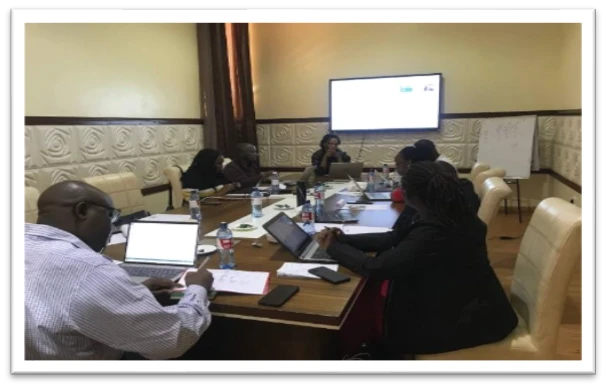
Together with two master’s students that she mentored, she began working with farmers to understand not just what they needed to know, but how they needed to receive the information. She secured high-capacity laptops, powerful enough to run complex simulations, which she took to the field. In the field, farmers provided the lived experience of the dairy cycle, and Dr. Nyambo provided the computational power to optimize it. This allowed for a mutual exchange of knowledge.
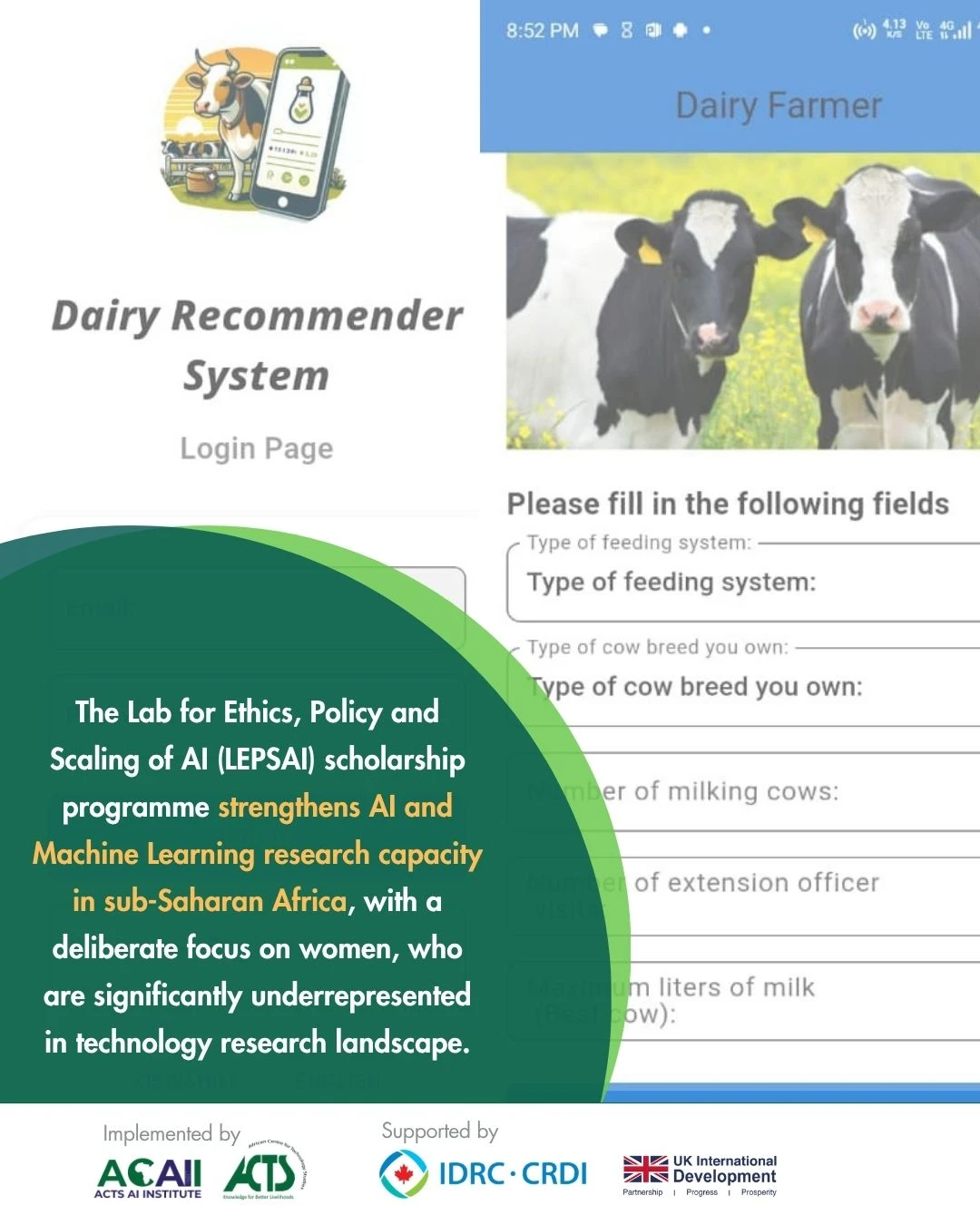
With information from farmers, they broke down the multi-agent model into two key tools; an advisory system to serve as a digital consultant that offers real-time recommendations on feeding, health, and environmental management, and a peer-to-peer networking platform that allowed farmers to learn from one another.
Further, through the scholarship, Dr Nyambo was able to learn about ethics in AI development. She underwent rigorous training in ethical AI, focusing on data integrity and the responsibility of the researcher to ensure that technology respects the humans it serves.
The final tool was validated by the farmers, and proved to be useful in providing real-time information that they need to improve their dairy milk production. Using this evidence, Dr Nyambo is pursuing resources to help scale this tool to farmers, as well as build long-term evidence that can speak to decision-makers and open conversations about specific reforms within dairy farming.
Looking Ahead
Tanzania’s dairy farmers still lag behind their counterparts in neighbouring countries. The gap that first captured Dr Nyambo’s attention remains wide. But the tools to close it are now real and tested.
For Nyambo, the journey from computational models no one could use, to AI tools that farmers can use, is proof that the most sophisticated science is only as good as its ability to reach the people who need it most.
“We have tried it with this group of farmers, and it is working,” she says. “Now, how do we create a strong evidence base to inform policy? That is the next frontier.”
She calls on governments to dedicate deliberate resources in scaling AI interventions so that the evidence base becomes strong enough to translate research into concrete policy reform.