
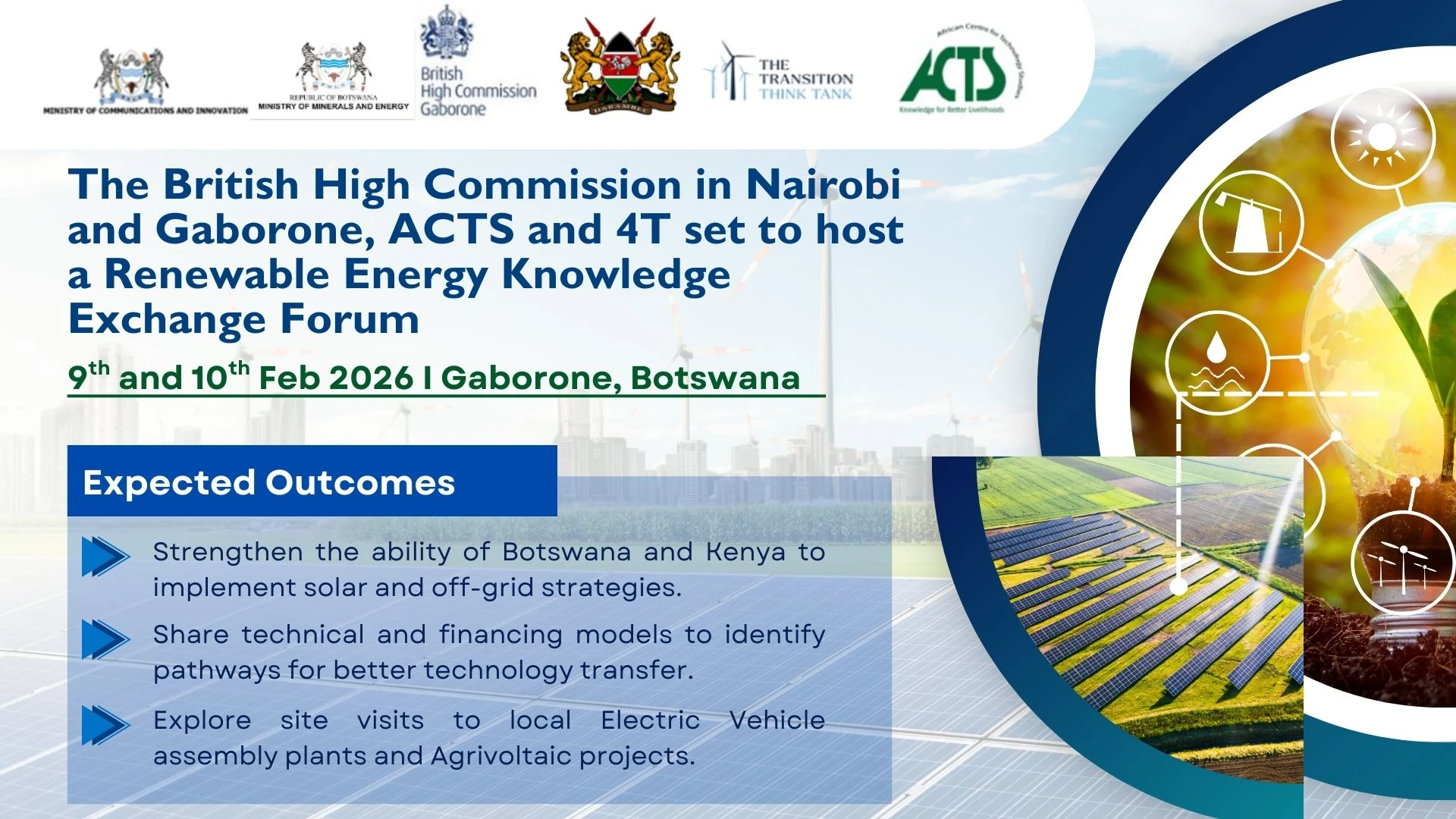
On the 9th and the 10th of February 2026, ACTS in collaboration with The Transition Think Tank (4T), with support from the British High Commission in Nairobi and Gaborone, will host a Joint Knowledge Exchange Workshop on Renewable Energy.
Renewable energy is no longer just an environmental imperative; it is a catalyst for job creation, economic transformation, and energy security across the continent. As nations race toward sustainable development, the need for collaborative, cross-border innovation has never been more urgent.
This initiative stems from a powerful trilateral commitment to renewable energy between the governments of the United Kingdom, Kenya, and Botswana reflected by national policies, including the UK’s Climate Change Act (2008), Net Zero Legislation (2019) and Clean Power 2030 Mission, Kenya’s Constitution (2010), Kenya’s Energy Act (2019), Integrated National Energy Plan Framework and National Energy Policy 2025-2034, and the Botswana Energy Compact that is guiding the country’s diversified energy mix and renewable energy penetration.
Grounded in robust policy frameworks, including Kenya’s National Energy Policy 2025-2034 and the Botswana Energy Compact, this collaboration leverages the unique strengths of each nation to accelerate the deployment of inclusive and affordable energy solutions. This programme ensures that renewable energy transitions uphold the core principles of equity and environmental sustainability by bridging the gap between policy and practice.
The Gaborone workshop, hosted at the Botswana Digital and Innovation Hub, serves as the inaugural session of a broader programme designed to strengthen institutional capacity and foster peer-learning.
The workshop will focus on institutional arrangements, regulatory frameworks, and identifying pathways for better technology and financing models, with discussions covering solar deployment, mini-grids, gender-responsive policy design, and infrastructure grid integration.
The ultimate goal of this exchange is to move toward actionable outcomes, including the development of a Trilateral Policy Framework Comparison Matrix, and the establishment of a Green Innovators Network.